Mondays and Wednesdays at ☕ **8 am OR** 🌄 **10 am**
This course introduces historical thinking skills with digital tools, sometimes called the digital humanities, while covering the history of humanity from 4000 BCE to 1400 CE.
As a college-level history course in 2025, this course requires you navigate new digital environments, such as this web page. Please ask questions, on our discussion boards, during student office hours, by email, and phone.
The thematic question we’ll ask this semester is how did pre-1400 CE peoples access, use, and make meaning with fresh water? 💧
🏗️ You’ll be part of one of five teams this semester, building a research report over the course of the semester. The five projects involve writing research reports for: a historical novel, a historical role playing video game, preparing a disaster response team, creating a shoe and clothing brand, or project managing one of these four projects.
Details and dates for assignments are on our schedule page.
“True peace required the presence of justice, not just the absence of conflict.” ― N.K. Jemisin, The Killing Moon
“Learning is always rebellion . . . Every bit of new truth discovered is revolutionary to what was believed before.” Margaret Lee Rubneck
There are no prerequisites for this course, and you do not need any specialized knowledge. The class will be taught in English, with occasional cheesy jokes and mild vulgarities in Spanish.
Studying history has changed dramatically in the last 20 years. People today publish more lies about the past than evidence-based history. For your parents, finding historical information was the challenge. For you, sorting credible from non-credible information will be the defining feature of your historical work, and indeed your information life.
I want you to learn about the past, learn new skills about how to analyze and present about the past, and learn new ways of how to learn (called metacognition). The learning goals, or outcomes, fit in these three groups. The goals for this course are below. I may sometimes call these learning outcomes, or the stuff I want you to be able to do by the end of this course.
You will be able to:
Email: jack.norton [at] normandale.edu
Email is the best way to reach me. I respond to emails and calls within 24-36 hours Monday-Friday (most of the time much faster). On weekends I respond by Sunday evening.
9-10 am 11- noon, Mondays and Wednesdays Noon to 1, Tuesdays College Services 3050 and Online
Additional phone and video chat times are available by scheduling an appointment with me.
Student check ins are when I am available to chat, by phone or video. You can schedule a specific time to meet with me, or just call me. Book an appointment with me.
If you feel any symptoms, please do not come to campus.
The regular grading policies in this syllabus provide that a student could not turn in two weeks of assignments and suffer no grade penalty.
If you or a family member you care for are incapacitated by COVID or any other debilitating disease, we can work on a schedule to allow you make up an additional two weeks of material beyond the regular schedule. Missing more than four weeks of the course and passing the class is not realistic and we should talk about your options.
BONUS: Bug hunt- If you find an error in any course materials that can affect learning (a broken link, an omitted word that changes the meaning of an assignment), please tell me about the bug on Discord with "#bughunt" as the tag. I save up the bug hunt bonusses and apply them to final grades that are very close to the next letter grade. Reporting minor bugs, such as a mis-formatted web page or non-learning related spelling error, earn my thanks.
E-Learning- What you need to know
If you need technology help, you may call our IT help desk at 952-358-8181. Even better, ask them a question on Normandale's “Ask Us” page, which will help track your request.
**Late Work-**There is no late work. Instead, I drop the equivalent of two weeks of work, or a 12% curve. This means you can miss assignments for two weeks, for any reason, and it will not affect your final grade.
Reading and Writing- This is a reading and writing-intensive course. You will read up to 75 pages a week and write at least 16 pages of typed, doubled-spaced pages of text (total, not all at once). Writing guidelines for each assignment will be discussed in course and included on the assignment.
Written work will be submitted to your own cloud-based (web backed-up) file using Office 365 or google docs. Instruction for setting up your own Assignment Fils will be on our course page. We will also use the D2L discussion board.
Assessment: Assessment means measuring your learning, I can do this by asking you questions, indicating if your answers are correct or not, and giving you a grade. Grades are the way I assess your learning. I can also assess your learning by teaching you the tools of historical thinking, having you build historical arguments, and then asking you to evaluate your work. Both grading and self evaluation will be key elements of assessing your learning.
Academic Standards
Students in this course will adhere to the rules of Normandale Community College’s Code of Conduct. Such rules prohibit plagiarizing another student's work (taking credit for someone else’s work or stealing work from the web) and creating a hostile academic environment for students or staff. Refer to your student handbook for the full Student Code of Conduct or see: here. We will work through how to properly cite material during the semester. Please be aware that the penalty for plagiarism is failure of the assignment, then possibly the course, and possibly dismissal from the College.
All sources of your work, including Artificial Intelligence such as ChatGPT, should be cited. We will NOT be using ChatGPT or other Ai for your writing.
American Disability Act (ADA) Statement
Normandale Community College is committed to equal access for students with disabilities through the services provided by the Office for Students with Disabilities (OSD). If you experience educational barriers because of a disability, please make an appointment for an intake/interview to discuss these barriers and to implement appropriate accommodations for your Normandale courses. Schedule an appointment by calling the OSD staff at 952-358-8625, emailing [email protected], online at normandale.edu/osd, or by stopping by the L2751 office. This syllabus is available in alternate formats upon request.
Title IX Statement
Normandale is committed to providing a safe and inclusive learning environment for all students. In response, the Title IX team is available if you experience sexual misconduct, sexual assault, or stalking, or if you are pregnant or breastfeeding and need course accommodations. For assistance, contact the Title IX staff at [email protected] or obtain specific information here: https://www.normandale.edu/current-students/tutoring-and-support/sexual-violence/index.html
Beena Cook, Director of Title IX, [email protected] 952-358-9187
Last Day of Attendance (LDA) Statement
Students are expected to attend all class sections or, for online and hybrid courses, participate starting the course begin date. If you don’t attend the first week of the course, you will be reported for non-attendance, which will assign a grade of NA. If you stop attending during the term for two weeks or more, you will be reported as no longer attending, and you will be assigned a grade of NW. When you are reported for attendance, you will no longer be eligible to attend or participate in the course, but you will remain obligated for tuition and fees. Financial aid may back off from classes you are not attending.
Satisfactory Academic Progress Statement
Normandale Community College, the Minnesota State Colleges and Universities, and Federal and State law require that a student makes satisfactory academic progress towards a degree or certificate to attend the College and remain eligible for financial aid. The standards, briefly described below, are cumulative and include all periods of enrollment.
Minimum Academic Standards:
Grade Point Average: cumulative GPA must be 2.00 or higher.
Completion Percentage: students are required to successfully complete a minimum of 66.66% of all courses attempted
Changes? Changes will be announced on our course website at https://jacknorton.org/courses
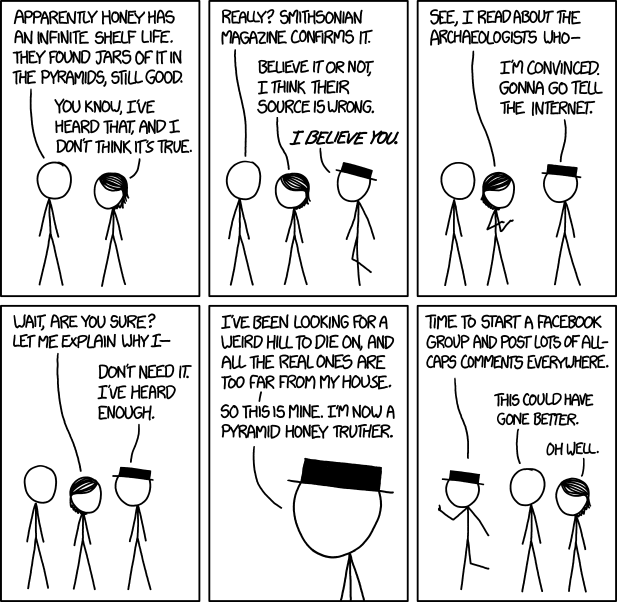
http://imgs.xkcd.com/comics/pyramid_honey.png
I reserve the right to amend this syllabus to better facilitate students’ learning. Changes to the syllabus (if any) will be announced in the news section and an amended syllabus will be posted on the class website.
<aside> 💡
I have a high tolerance for human error, and no tolerance for Generative Ai.
No work that appears to be Ai will receive a grade, until I am satisfied with the academic integrity of the work.
Any group work that appears to have Ai in it will also not receive a grade for anyone until we have talked about the work and I am satisfied with the work’s academic integrity.
</aside>
Assignment Descriptions
Most weeks you’ll do one of the following types of assignments, sometimes every assignment.
Overall Grades Weights
| --- | --- | --- | --- | --- |
Late assignments and grade drops.
Late work is not accepted nor are extensions offered except in the case of hospitalization or deployment.
This work is licensed under a Creative Commons Attribution-NonCommercial-ShareAlike 4.0 International License

