Why AI pressure may be the best opportunity in years to turn a technology programme back into a business transformation
Christian Kroschl · August 2026
Boards want higher productivity, lower headcount, less working capital, fewer write-offs, better service and protected revenue. Agentic AI is the current vehicle for that expectation, and supply chain leaders are expected to answer, often while their planning transformation is still running.
What follows is written for the supply chain leader, not the board directly. The mechanics and the evidence are the leader's homework. The board only needs what comes at the end, in What the board needs to decide and The position.
The predictable response is a workshop. Forecasting agents, inventory agents, scheduling agents, S&OP copilots, autonomous planning. The ideas get ranked by value and feasibility, turned into a roadmap, and presented as progress.
A use-case list creates activity. It does not create value.
An agent has no business case. A changed decision has one.
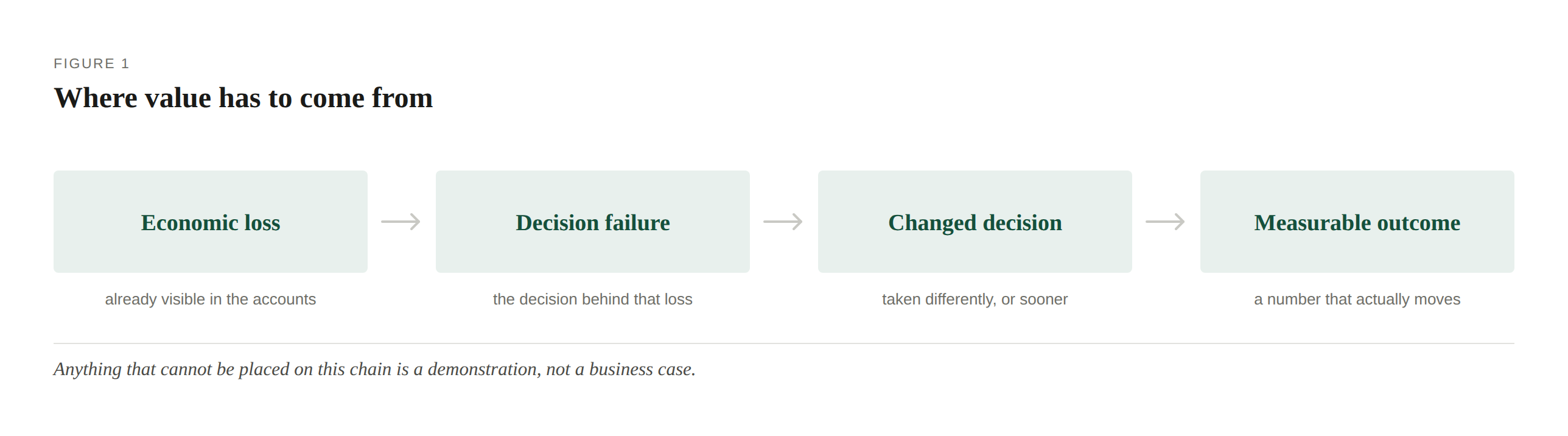
Value appears along a single chain: economic loss, decision failure, changed decision, measurable outcome. Anything that cannot be placed on that chain is a demonstration.
Most of ours are not. Making them readable is the work, it is finite, and it produces value with or without an agent.
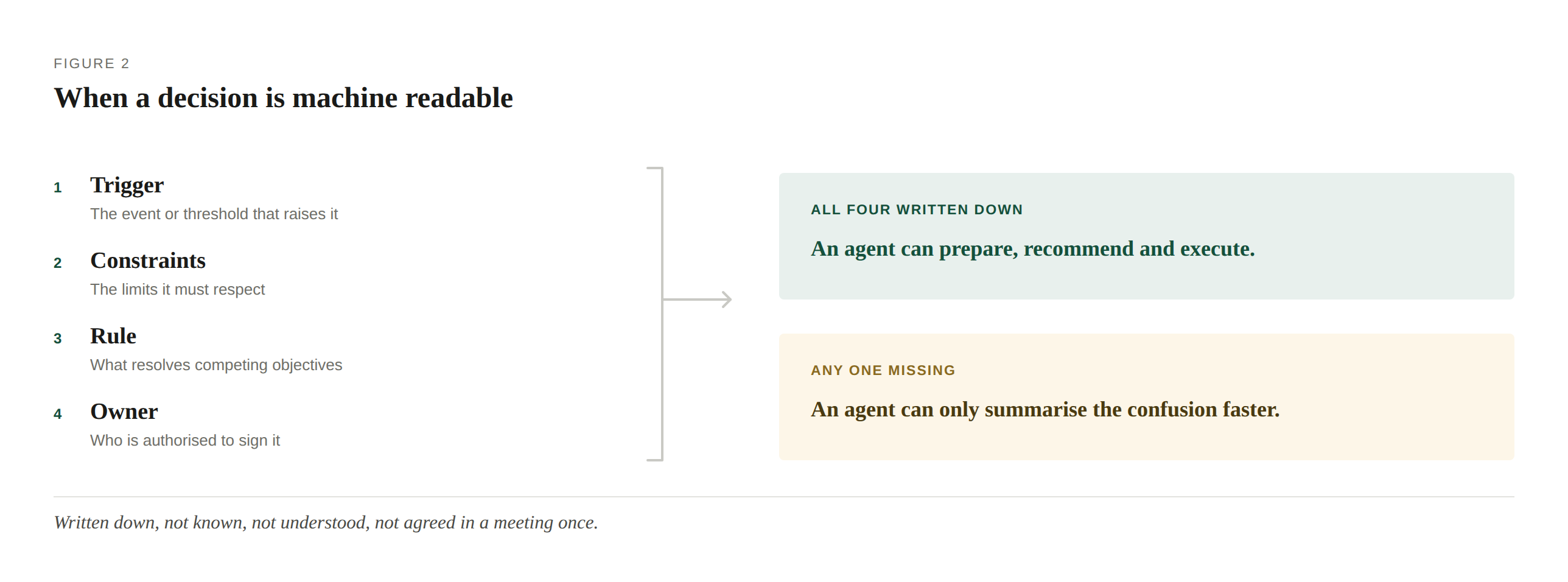
A decision is machine readable when four things are written down. The trigger that raises it. The constraints that bound it. The rule that resolves it. The owner who signs it.
Where those exist, an agent can prepare, recommend and eventually execute. Where they do not, an agent can only summarise the confusion faster.
That is not a reason to wait. It is the value case.
The claim now being sold is that agents read transaction data, infer what is going on, and clean master data becomes optional.
The distinction is narrow but decisive: transaction data can reveal the measured value. It cannot reveal the business intent behind it.
Derivation from transactions is correct for the measured value and worthless for the intent. Actual lead time is a distribution and it comes from movements, as it should. Which point of that distribution becomes the planned lead time comes from a service decision, and that decision appears in no movement anywhere. A parameter is the intent.