question:What happens if I post during the 3–6 AM "dead zone"?
answer: Posting during this window severely damages your reach. The initial distribution phase occurs when your followers are largely inactive, leading to a near-zero interaction velocity. By the time peak user hours arrive, your post is already buried under newer content from other accounts.

question:Why do the top data studies recommend different target time slots?
answer: The variation comes down to metrics and collection methods. Sprout Social calculates total engagement volume, favoring broad peak windows like Wednesday afternoons. Buffer evaluates median engagement rate, highlighting high-efficiency micro-windows like Thursday morning at 9 AM, where fewer brands are competing for the active audience's attention.

question:Should I change my posting times if I am posting a Reel vs. a Photo?
answer:No.The core datasets prove that format does not alter audience behavior. Your followers are on the app at the exact same hours regardless of whether they are consuming Reels, carousels, or static photos. Stick to the same baseline daily windows across all feed content formats.

question:My industry peaks on weekends. Should I ignore the weekday benchmarks?
answer:Yes. If your specific niche operates on a weekend schedule—such as food, retail, hospitality, or local weekend experiences—your specific data takes complete precedence. Always align your posting strategy with when your specific target demographic is prepared to take action or consume your specialized content.
A data-driven guide to maximising your reach, engagement, and algorithmic visibility — backed by analysis of billions of interactions.
■ At a Glance — Key Findings
| Metric | Finding |
|---|---|
| Best days overall | Tuesday, Wednesday, Thursday |
| Top single day | Wednesday |
| Best posting windows | Mon 2–4 PM · Tue 1–7 PM · Wed 12–9 PM · Thu 12–2 PM |
| Top 3 time slots (Buffer) | Thu 9 AM · Wed 12 PM · Wed 6 PM |
| Evening rule | 6–11 PM drives strong engagement every weekday |
| Worst days | Saturday & Sunday — avoid for brand content |
| Worst times any day | 3–6 AM — dead zone, almost zero reach |
| Reels vs. Photos timing | Same windows apply — format does not change peak hours |
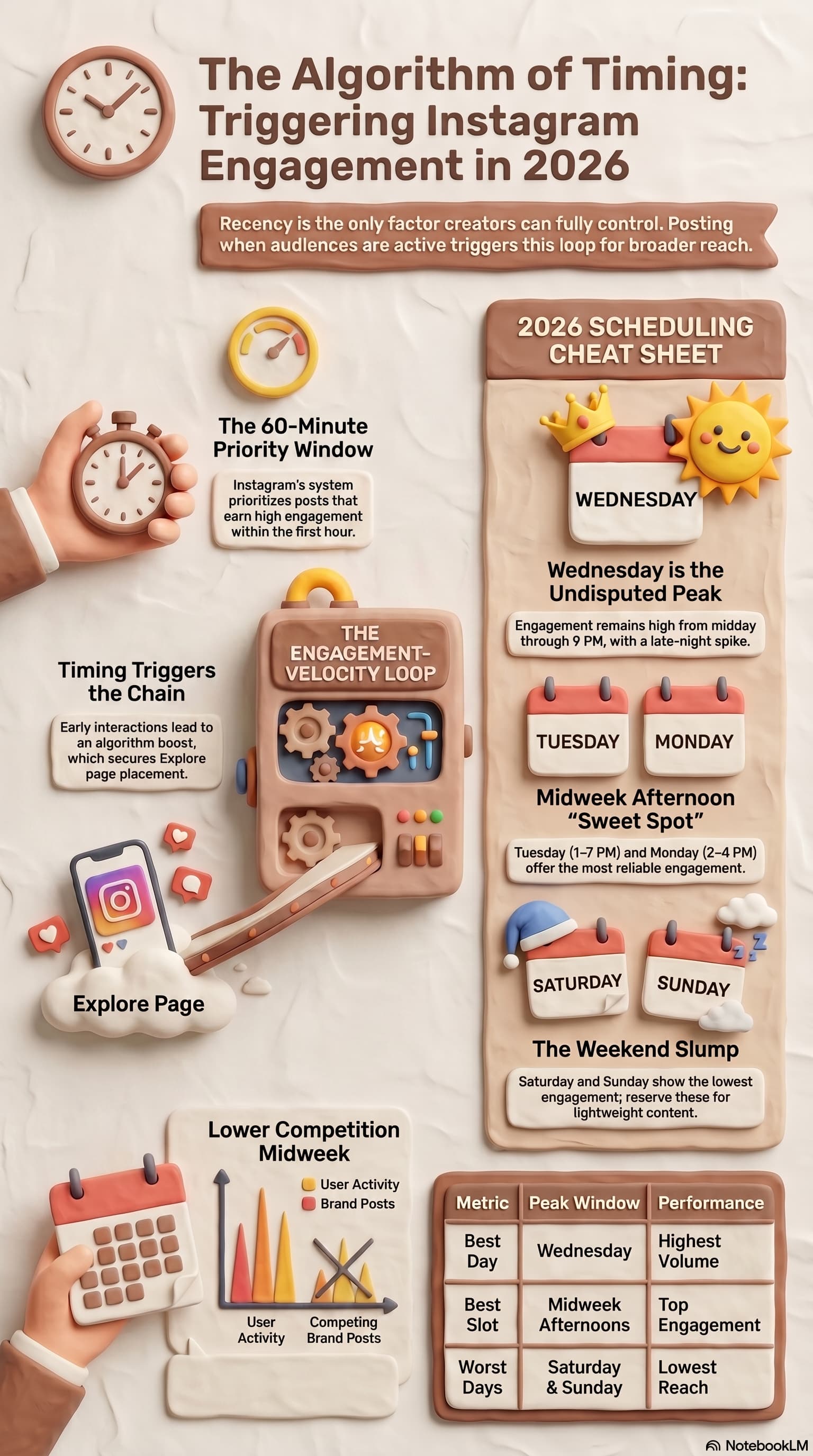
Instagram is no longer a simple reverse-chronological feed. The algorithm blends recency, relevance, and relationship signals to decide what any given user sees first. Of those three pillars, recency is the one you can control completely — and it has an outsized knock-on effect on the other two.
When you publish at the right moment, your content collects likes, comments, shares, and saves while your audience is actively online. That early-engagement burst is interpreted by Instagram's ranking system as a quality signal, which then pushes your post to a wider secondary audience — people who don't even follow you yet. Publish at the wrong time and the same post could earn a fraction of that reach.
The engagement-velocity loop: Early interactions → algorithm boost → Explore page placement → more followers → even stronger future posts. Timing triggers the entire chain.
Rather than relying on a single source, this guide synthesises two of the largest independent datasets published in 2026, covering combined billions of data points.
| Feature / Metric | Sprout Social 2026 | Buffer State of Social 2026 |
|---|---|---|
| Posts / Engagements | ~1.9 billion engagements | 9.6 million Instagram posts |
| Profiles / Accounts | 307,000 global profiles | 200,000+ accounts |
| Study period | Nov 2025 – Feb 2026 | Jan 2024 – Dec 2025 |
| Metric used | Total engagements | Median engagement rate |
| Best single day | Wednesday | Wednesday |
| Top time slot | Tue 1–7 PM / Wed 12–9 PM | Thu 9 AM / Wed 12 PM / Wed 6 PM |
| Worst day | Saturday & Sunday | Friday & Saturday |
Both studies agree on Wednesday as the top day and midweek afternoons as the peak window, providing strong cross-dataset confidence.
Use this as your scheduling cheat sheet. All times are in your audience's local time zone — adjust accordingly if you serve a global or multi-timezone audience.