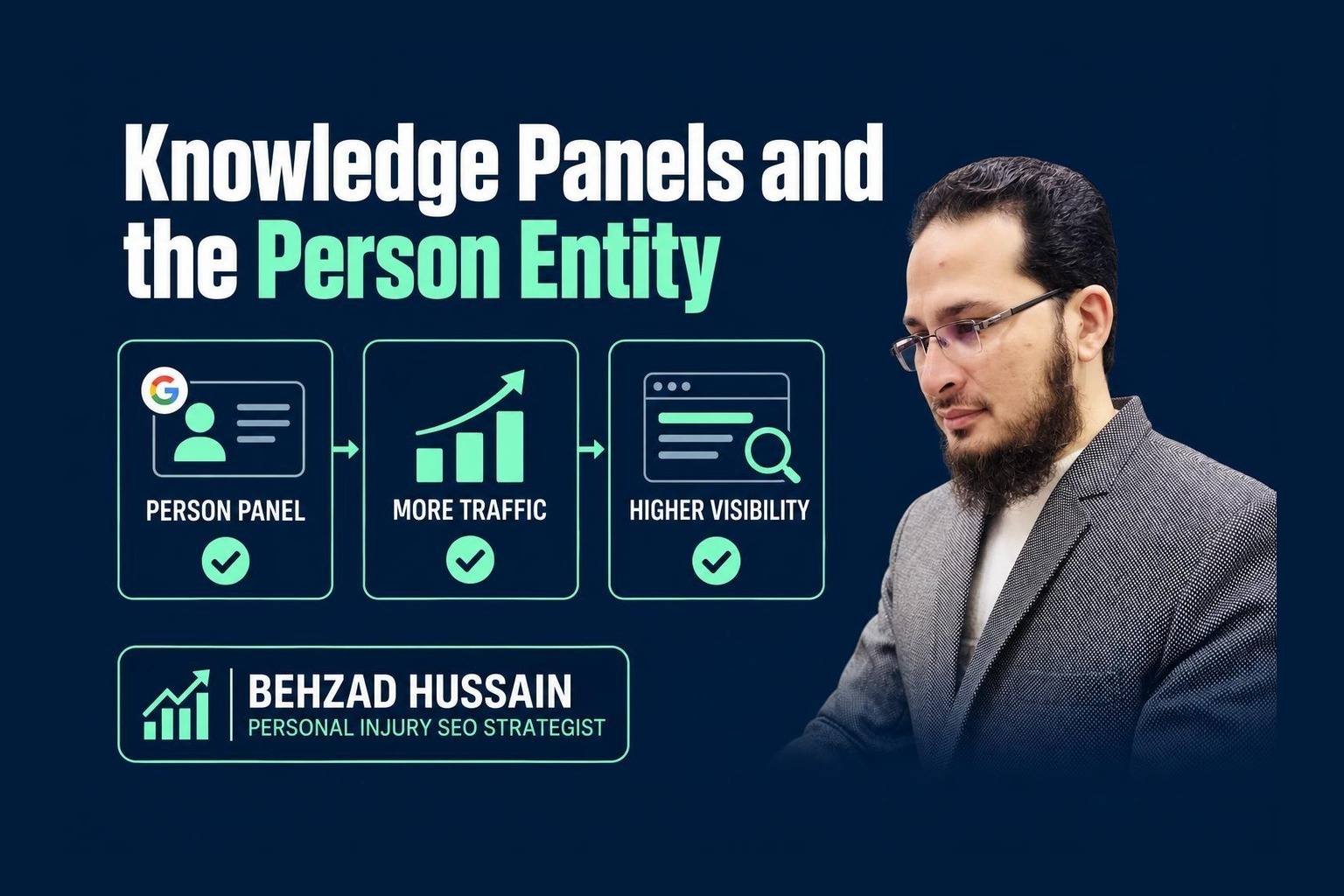
The strongest under-used asset in personal injury marketing is not a page. It is a person. In my audit of 1,005 US personal injury attorneys and firms, profiles holding a person knowledge panel indexed at 2.95 times the cohort median for organic traffic, while profiles without one sat at 0.68 times. Google is increasingly organizing trust around recognized people, not just business listings, and almost no firm is competing for it. Here is the mechanism and the playbook.
The panel, the card that appears beside search results for a resolved entity, is not a reward Google hands out. It is a symptom: the visible sign that the machine has gathered enough consistent, corroborated information about an entity to stake a summary on it.
The mechanics are patented and old. US 9268820 defines the panel template itself. US 8682913 describes corroborating facts across multiple sources before trusting them. An entity earns a panel when the open web tells one coherent story about it, repeatedly, from sources the machine respects. No coherent story, no panel, no matter how accomplished the attorney.
That is why nobody can legitimately sell you a guaranteed panel. What can be built is the record that produces one: a definitive home for the facts, and an ecosystem that repeats them.
Two findings from my published research reframe where the leverage sits.
From the Knowledge Panel study across 1,005 attorneys and firms: person-panel holders at 2.95x the cohort median for organic traffic, non-holders at 0.68x. The gap between being a resolved person and being a name on a page is not marginal. It is the difference between multiples.
From the companion Brand Demand Flywheel study across 1,000 firms: brand search demand correlates with organic traffic at 0.41, and person panels associate positively with traffic (+0.179) while business-only panels sit slightly negative (-0.049). Read carefully, this does not say panels cause rankings; I do not claim mechanisms my data cannot support. It says the firms people search for by name, and the attorneys who exist as resolved people, sit measurably ahead of the market on the traffic that matters.
The strategic read: the industry pours everything into the firm listing and treats attorney identity as a bio page afterthought. The data says the afterthought is where the differentiation lives.
Answer engines inherited the entity plumbing. When a machine assembles "who handles truck accidents in this city," it names entities it can verify, and a verified person, with bar admissions, case-type expertise, publications, and a consistent record, is among the most verifiable things the web contains.
My SERP Authority Report shows how empty this field is in practice: 663 of 1,005 page-one firms are structurally absent, and only 11.1 percent of AI citations on PI queries are on-topic. The answer layer is starving for named, verifiable authorities in this vertical. An attorney built into a resolved entity is precisely the citable object it is looking for, and almost nobody has built one.
Give the facts one home. One definitive page, typically the attorney's bio on the firm site, that states the record: full name, role, bar admissions, case-type expertise, education, publications, recognitions. Structured data on that page declaring the attorney as a Person, connected to the firm with worksFor. This is the reference point everything else corroborates.
Make the record deep enough to matter. A photo and a paragraph resolve nothing. Cases, results within bar rules, real publications, real speaking, real credentials, stated plainly. Machines extract entity attributes from text, US 11263400 describes exactly that pipeline, and thin text yields a thin entity.
Then make the web agree. Bar profiles, reputable directories, the firm's own pages, any coverage: same name, same facts, same expertise, everywhere. Every consistent repetition is a corroborating witness. Every contradiction, an old bio, a stale directory, a name spelled two ways, withdraws confidence exactly where confidence is the currency.
And let the person publish. The attorneys with the strongest entity records share a trait: they exist as sources, not just service providers. Real answers to real questions, under their own name, on the topics they want to own. It is the slowest input and the one that compounds hardest.
Sequence matters here as much as anywhere in my method: home first, depth second, corroboration third, publishing always. Firms that start with directory blasts before the definitive bio exists are corroborating a record that is not there yet, which is how attorneys end up with five conflicting versions of themselves and no panel.