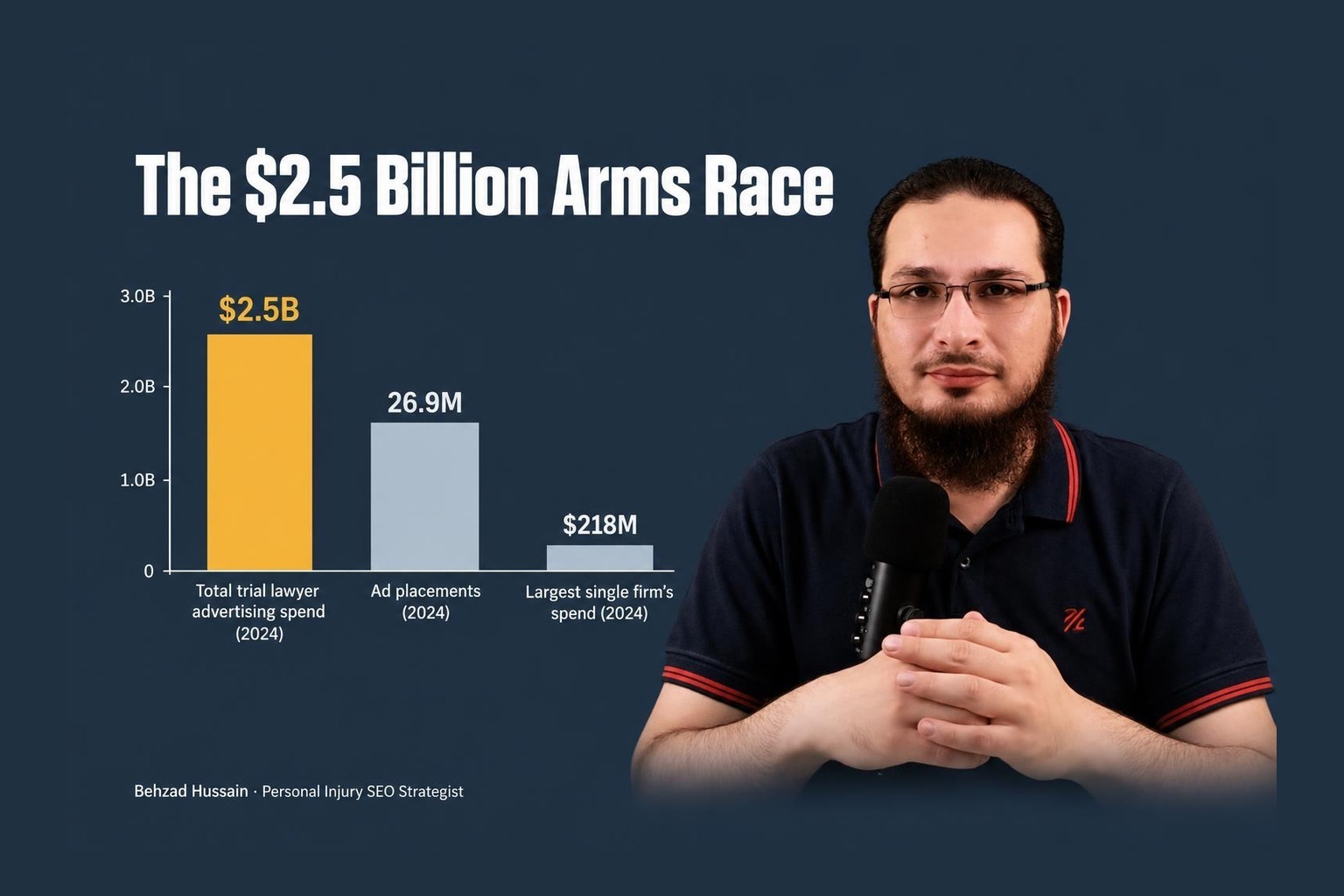
Trial lawyer advertising reached $2.5 billion a year, spread across 26.9 million ad placements in 2024, with the largest single firm accounting for roughly $218 million of it by itself. Those are the American Tort Reform Association's counts, and every personal injury firm owner should read them not as industry trivia but as the rules of a game they are being invited to lose. This piece is about what the arms race actually selects for, what it structurally cannot buy, and where the counter-position sits for firms without a nine-figure media budget.
Hold the three numbers together and the game reveals its structure.
$2.5 billion is the annual entry fee for share of voice, and it ratchets: every escalation by one major spender resets the floor for everyone contesting the same eyeballs. 26.9 million placements is what saturation looks like; in major metros an injured person cannot ride a bus, watch a game, or open an app without meeting the category. And $218 million from a single firm is the checkmate number: it tells you exactly who wins any contest decided by budget, before the contest begins.
The economics underneath are the ones I publish on my own methodology pages: commercial PI clicks priced between $100 and $300, signed cases from paid channels running $1,000 to $5,500 before a dollar of casework begins. Rising, all of it, because auctions with more bidders and fixed inventory only move one direction.
None of this makes advertising irrational. For the giants, saturation is the strategy, and by its own logic it works: category dominance, name recognition at scale, a moat made of budget. The question the numbers pose is narrower and more personal: what is the rational play for the firm that cannot and will not win a bidding war against a $218 million budget?
Here is where my audit data turns the spending data into strategy, because the two datasets describe the same firms.
While the industry spent $2.5 billion on placements that expire, my 11-question structural audit of 1,005 page-one PI websites found a market that finished almost nothing: a mean score of 3.13 out of 11, two thirds of firms structurally absent, and not one firm in the entire cohort above 7. The most famous name in the study, the same tier of firm anchoring the ad-spend leaderboard, scored highest at 7 of 11 while its mobile pages took nearly 23 seconds to render.
That is the strangest fact in this vertical, and I have now measured it from enough directions to call it load-bearing: the biggest spenders in legal marketing rent attention at historic scale and leave the owned layer, the structural foundation that compounds instead of expiring, unbuilt. The arms race consumes exactly the budgets, attention, and vendor relationships that finishing would require. Saturation spending and structural completion appear to be organizationally incompatible, and the data shows it: money is everywhere on the leaderboard, and finished foundations exist nowhere on it.
Which means the empty ladder is not despite the $2.5 billion. It is partly because of it.
I write often about rented versus owned acquisition, and the ATRA numbers give the distinction its sharpest form: all 26.9 million placements from 2024 are gone. Every one. The meter reset to zero on January 1, and the same share of voice now costs this year's price, which is higher.
Contrast the asset side. A complete practice-area resource built three years ago is still answering questions tonight, stronger for its age, because the machines that decide visibility are engineered to reward accumulated, stable, corroborated records. Rented reach resets annually at rising prices; built authority compounds annually at zero marginal price. Two curves, opposite directions, and every year the gap between them widens.
The rational blend for a non-giant follows directly. Paid channels as a bridge, sized to keep the pipeline alive, never mistaken for a strategy. And a fixed, protected share of budget flowing to things the firm still owns if every vendor vanishes: the structural layer, the case-type depth, the attorneys as resolved public records, the intake that answers. Rent to eat; build to own; never confuse the meter for the deed.
The giants' model has one structural weakness a smaller firm can actually use: it requires being everywhere, which is why it finishes nothing anywhere. A firm that picks one metro and two case types can complete work the saturation model cannot afford to complete anywhere, and completion is what the measurement machinery pays.
Concretely, from the audit data, the counter-position is four moves. Clear the structural bar nobody clears; the observed ceiling is 7 of 11, held by five firms nationally. Own the case-type questions completely in your market, because depth is a decision, not a media budget. Build the named attorneys into corroborated public records, the layer four fifths of page one ignores. And wire intake so the demand the giants generate, because $2.5 billion of category advertising creates searches that ads do not finish, lands somewhere that answers.
That last point deserves its own sentence: category saturation is a subsidy to whoever wins the search that follows the billboard. The arms race manufactures demand for injury representation in general; the structural winner in each market collects a share of it without paying the toll.