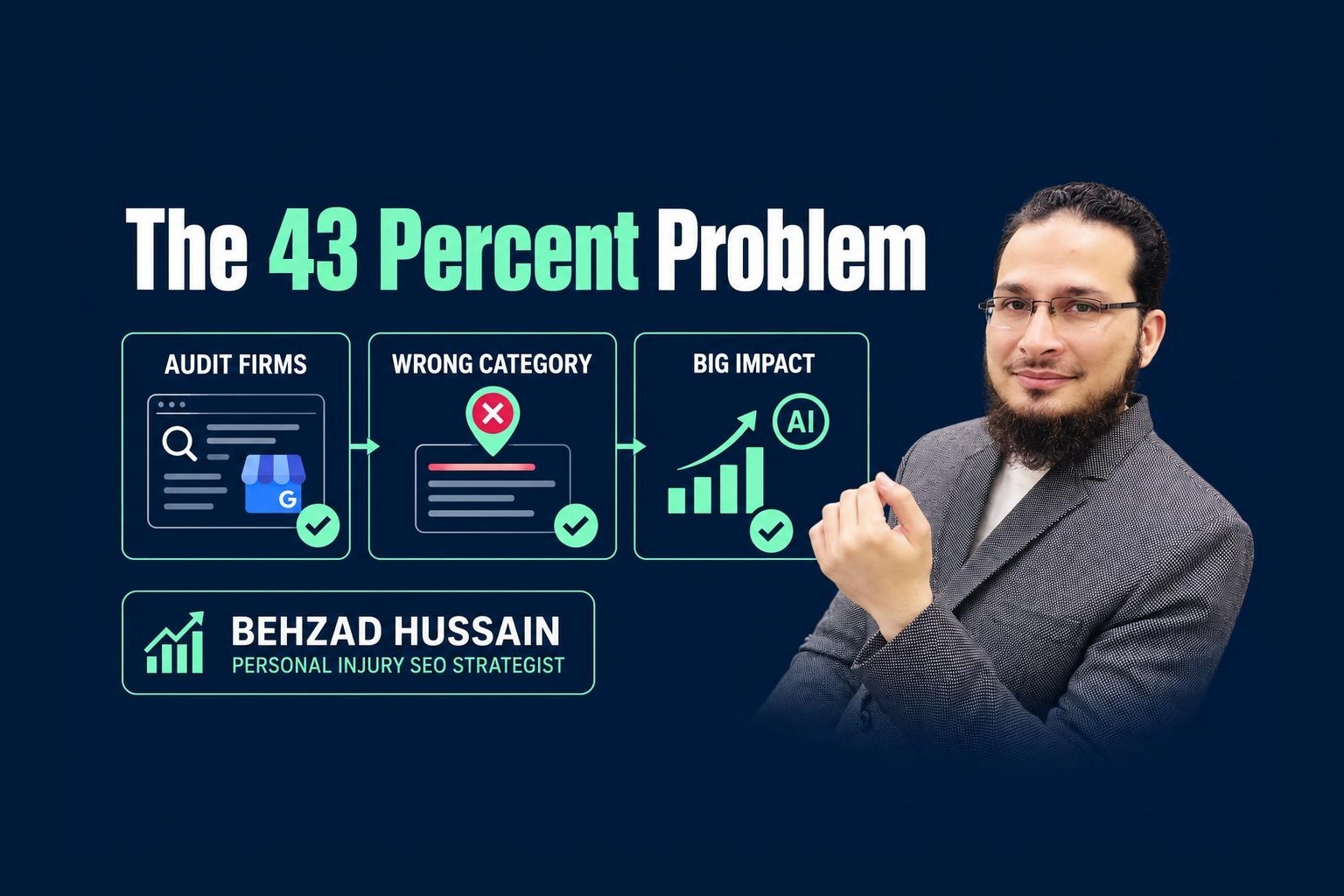
43 percent of the 1,005 page-one personal injury firms I audited sit under the wrong primary Google Business category. It is the single strangest number in a year of measuring this industry, and the cheapest fix in legal marketing. This piece explains what the number means, why it happens, why it matters more in the AI era, and the two-minute check every firm owner should run today.
The study behind this number audited the Google Business Profiles of 1,005 US personal injury law firms, every one of them ranking on Google page one, across a nine-attribute framework: category, hours, reviews, photos, and the rest of the fields Google exposes. One profile at a time, hand-checked, over weeks.
The headline findings, in order of how much they should change your behavior:
95.9 percent of firms have a profile. Presence is solved.
Mean completeness was 7.05 out of 9. Filling in fields is solved too. Almost everyone does it.
Completeness showed almost no correlation with rank. The thing agencies report as progress differentiates nobody, because everybody has it.
And 43 percent sat under the wrong primary category. The one field that carries the most relevance signal is the one nearly half the winners got wrong.
Nobody chooses the wrong category on purpose. It happens in three mundane ways.
A vendor set up the profile years ago, picked something generic, and left. The firm inherited the setting and nobody has looked at it since, because nothing looks broken.
Or the firm chose a broad category deliberately, reasoning that wider must mean more visibility. The opposite is true: the category is not a net you widen, it is a declaration you sharpen. Generic tells Google you are generically relevant, which in the most competitive vertical in search means relevant to nothing in particular.
Or an office was added, a profile was merged, a suggestion was auto-accepted, and the setting drifted. Profiles are living records that other people can propose edits to. Unwatched, they drift.
The mechanism is documented, not speculative. Google holds a patent on categorization of search results, US 8498984, and the local stack leans on category signals to decide which businesses even enter consideration for a query. The primary category is the strongest single statement of what you are.
It also does not work alone. The machine cross-checks: does the category match what the website's structured data declares? What the practice pages say? What the directories repeat? Google patented corroborating facts across multiple sources, US 8682913, more than a decade ago. When your profile says one thing and your site says another, or says nothing, confidence drops, and confidence is what gets a firm into the map pack and into AI answers.
That is what makes the 43 percent finding worse than it first sounds: in my companion audit of the same firms' websites, only 35.3 percent declared themselves a legal service in machine-readable form at all. For a huge share of the market, the two witnesses either disagree or one never testifies.
Category errors used to cost map rankings. They now cost more, because the answer layer inherited the same entity plumbing.