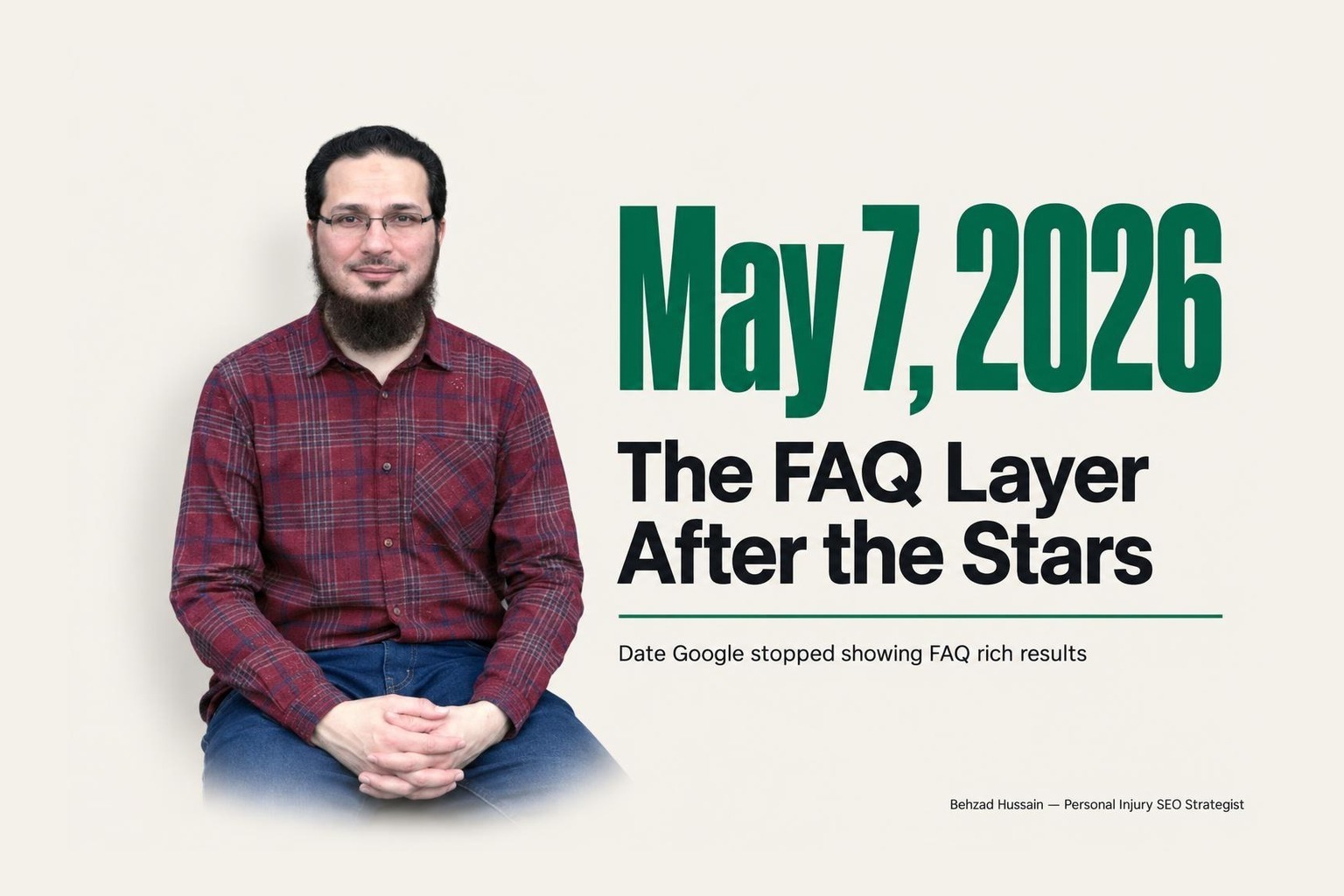
On May 7, 2026, Google stopped showing FAQ rich results, the expandable questions under search listings, for nearly all websites. Within days the industry produced its usual two camps: vendors declaring FAQ work dead, and vendors selling the same markup with a new AI-flavored promise attached. Both camps are wrong in instructive ways. What actually changed is a rendering. What did not change is the discipline underneath, and my audit data says only 18.5 percent of page-one personal injury firms ever built that discipline in the first place. This piece sorts the removal into what it killed, what it left standing, and what a PI firm should do now.
The FAQ rich result was a display feature: Google choosing to render a page's marked-up questions as interactive dropdowns on the results page. It had already been restricted to a narrow set of sites since 2023. As of May 7, 2026, it is effectively gone for everyone.
That history matters, because this is now the fourth time this industry has run the same funeral. Review stars for self-serving markup were removed in 2019. How-to results were retired in 2023. The sitelinks search box was retired in late 2024. Each time, content and markup built solely to trigger the widget became instantly worthless, and each time, the underlying structure, where it had been built for comprehension rather than decoration, kept doing its quieter job.
The pattern is the lesson: Google retires renderings on its own schedule and owes nobody notice. Strategies pegged to widgets carry an expiry date the buyer never gets to see.
Three things survived May 7 completely intact.
The questions themselves. Injured people did not stop asking whether they have a case, what it costs, whether it was their fault, how long they have. The demand side of FAQ content is a permanent feature of human distress, not a Google feature.
The comprehension value of structure. Marked-up question-and-answer pairs remain valid structured data that any system reading the web can parse: search engines building their understanding of a page, and the growing family of machines that assemble answers rather than lists. I will not decorate that statement with the adoption statistics currently circulating for AI systems, because I cannot verify them and my standard does not bend for convenient numbers. The verifiable core is enough: structure exists to remove ambiguity for machines, and nothing about May 7 made machines prefer ambiguity.
And the extraction value of well-shaped answers. A question stated in the reader's words, answered directly in the first sentence, in 40 to 70 words a frightened person can absorb, is the format that gets quoted, by answer engines today and by whatever renders answers next. That format was never really about the dropdown.
Here is the finding that reframes the whole panic: in my structural audit of 1,005 page-one PI firm websites, only 18.5 percent carried a structured FAQ layer at all.
Four out of five winners never built the thing whose rendering just disappeared. For them, May 7 changed nothing except the pitch they will receive next quarter. And the 18.5 percent who did build it split into two very different groups: firms whose FAQ layer was genuine, real client questions, properly answered, structurally declared, and firms who bulk-generated accordion boxes in 2021 because a vendor promised stars.
The first group lost a cosmetic. Their answers still rank, still get extracted, still serve the reader, and still feed the machine-readable record of what the firm knows. The second group lost the only reason their content existed, which is not a loss so much as an invoice arriving.
Strip away the widget history and the durable playbook for a PI firm's question layer looks like this.
Source questions from reality. Intake calls, consult transcripts, the questions clients say they typed at 2am. The panic questions and the embarrassed questions almost never surface in keyword tools, and they are where trust is actually won.
Answer on the page that owns the topic. A question that deserves its own section gets one, with the direct answer front-loaded. The FAQ block at the bottom of a page is for genuine leftovers, perspectives the body does not cover, never a duplicate of what the page already says. Machines do not need the same answer twice, and readers trust pages that do not pad.
Shape for extraction. Question in natural language. First sentence answers it completely. Two to four sentences of necessary nuance. No throat-clearing, no "great question," no paragraph of firm history before the answer.