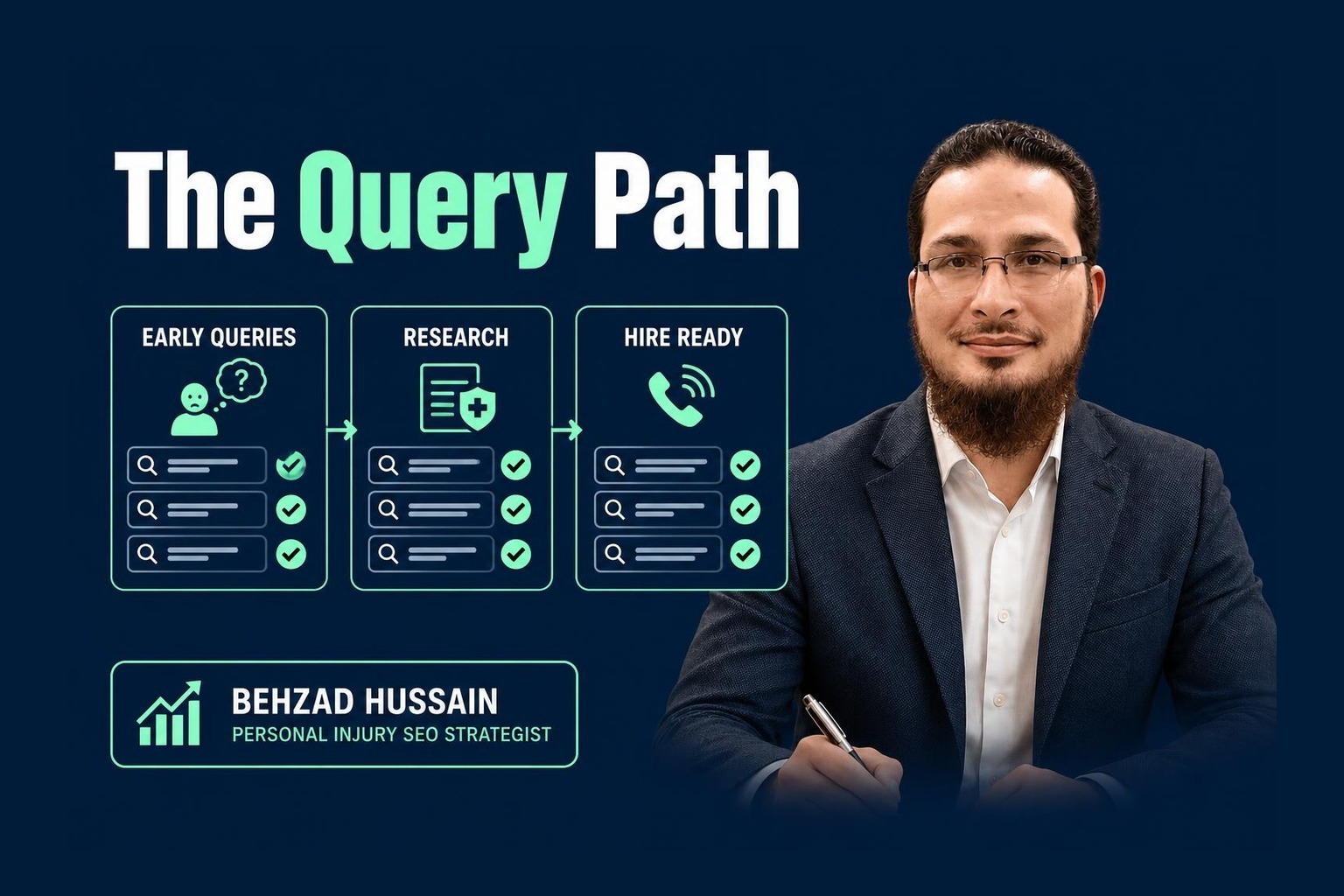
Between the moment of an injury and the moment a lawyer's phone rings, there is a path of searches: a sequence of questions that starts frightened and vague and ends specific and commercial. Most personal injury firms build their websites for the final query on that path and are invisible for every step before it, which means the client has usually formed their trust somewhere else before the firm's page ever appears. This piece maps the path, the machinery that reads it, and how a firm builds for the whole journey instead of the last step.
The sequence varies by case, but its shape is stable, and intake calls confirm it over and over.
It begins with symptom and situation queries, often the same night: whiplash how long after accident, should I go to the ER after a rear end collision, is the driver who hit me always at fault. No lawyer in these queries. The person does not yet know they have a legal problem; they know they have a neck problem and a fear problem.
Then come the quiet legal questions, usually typed at odd hours into a phone or an AI assistant: do I have a case if I was partly at fault, what is my claim worth, will I owe money if I lose, how long do I have to file in my state. This is the stage the embarrassment lives in. People ask machines what they are afraid to ask people, and the firm whose content answers these honestly earns trust before any human contact.
Then process and comparison queries: what does a personal injury lawyer actually do, contingency fee meaning, how to choose an injury attorney, questions to ask a lawyer first call. The person is now assembling a decision framework.
Only then, sometimes days later, the commercial head terms everyone fights over: car accident lawyer near me, truck accident attorney in their city. By this point the searcher is not discovering options. They are confirming a shortlist their earlier searches already built.
The patent record shows the search systems were built to read intent sequences, not isolated strings, and four documents make the point concretely.
Google patented determining user intent from query patterns, US 8868548: the system reads the pattern of queries, not each one in isolation, to infer what the user is actually trying to do. It patented identifying navigational queries, US 7693865, separating the searcher who wants a specific destination from one still exploring. It patented recognizing named entities inside queries, US 9009134, which is how truck accident lawyer El Paso, TX decomposes into a case type, a profession, and a place. And it patented query augmentation, US 8375048, expanding what you typed into what you meant.
Translate the stack into owner language: the machine sees the journey. It knows which stage a query belongs to, it rewrites queries into their meaning, and it matches pages against that meaning. A site with one commercial page per case type is legible to exactly one step of a multi-step path. The machinery has nothing to match the rest against, so somebody else's pages fill the gap, and increasingly so do answer engines assembling responses from whoever covered the early questions best.
The commercial head term is the most expensive, most contested, least differentiating query on the entire path, and it is where nearly every PI marketing budget is pointed. Three structural problems follow.
The head term is a confirmation query. By the time it is typed, trust has largely been allocated by the earlier steps. Winning the last click while losing the whole preceding journey means competing on the thinnest possible margin: position alone, against the deepest pockets in search.
The head term is also where everyone is identical. Every firm's page says the same words to the same query. The early-path questions are where a firm can actually be distinguishable, because almost nobody answers them properly, in plain language, with the state's actual deadlines and the process's actual shape.
And the head term teaches owners the wrong lesson about SEO, because its difficulty makes organic look hopeless. The path's earlier steps are winnable by any firm willing to do complete work; in my audit of 1,005 page-one PI sites, the overwhelming pattern was thin commercial pages with no question layer around them at all. The crowd is at the last step. The open ground is everywhere before it.
The practical build treats one case type as one network of questions, mapped end to end.
Harvest from reality first: intake calls, consult transcripts, the exact phrasings clients repeat. The early-path questions rarely surface in keyword tools, because tools sort by volume and the path's most valuable steps are low-volume, high-fear queries. Your intake team hears them daily.