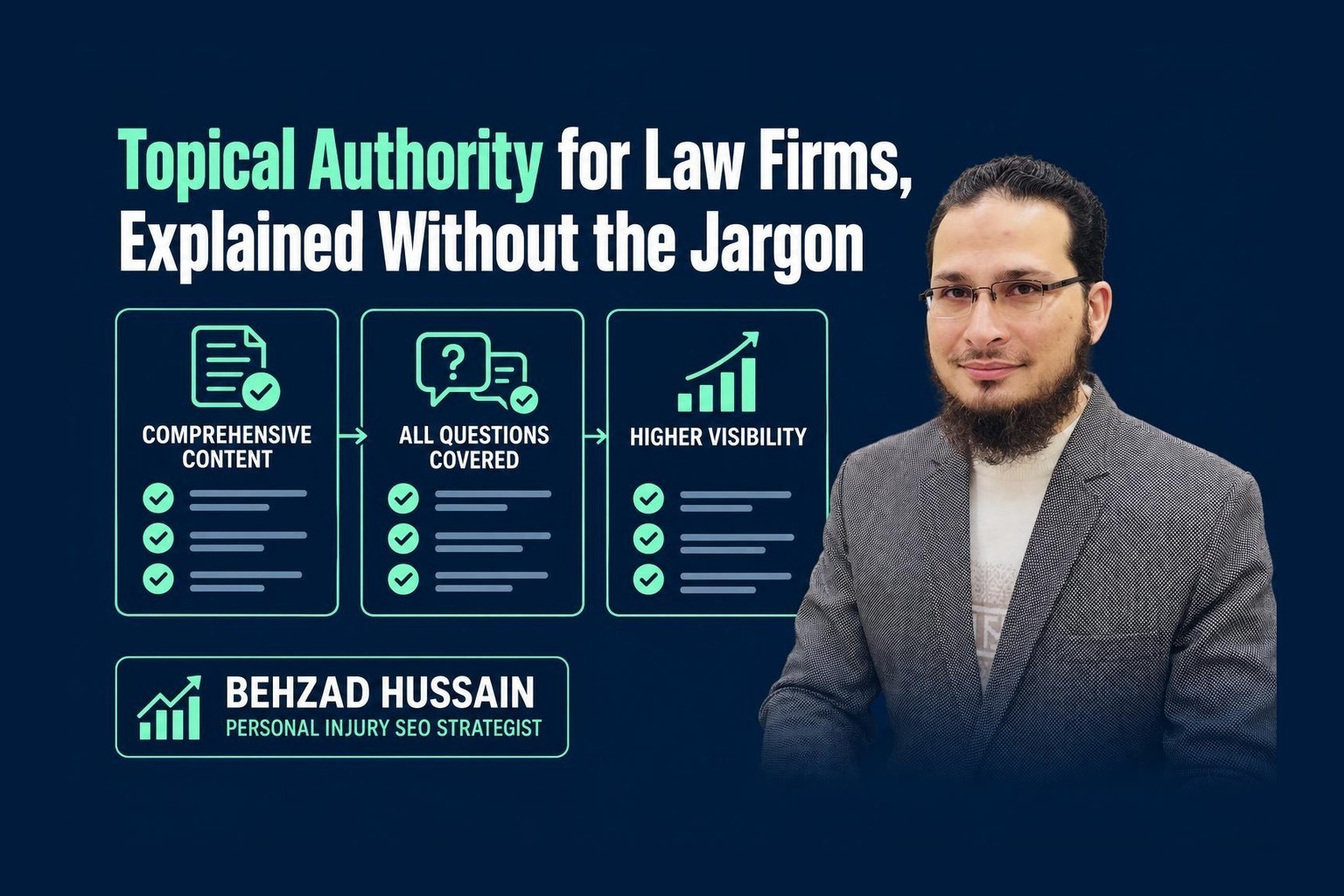
Topical authority is jargon for a simple, checkable state: you have covered a subject so completely that there is no obvious question left unanswered. For a law firm, reaching that state on even one case type changes how people, Google, and AI answers treat you, and my audit data says almost nobody in personal injury has done it. This piece explains the idea in plain English and gives the honest playbook.
Imagine two firms in the same city.
One has a car accident page. A paragraph, a stock photo, a call button. It says the firm handles car accidents the way a sign says a building exists.
The other has covered car accidents the way a knowledgeable friend would if you could ask them everything. What to do at the scene. Whether you have a case. What it might be worth. How long you have to file. What happens if you were partly at fault. How insurers actually lowball. What the process feels like month by month. Each question answered properly, in plain language, all of it connected.
Now ask which firm knows the subject. You did not hesitate. Neither does the machine. That difference, provable coverage, is the entire concept. Everything else written about topical authority is decoration on this.
The mechanism is documented, not mystical. Google moved years ago from matching words to matching meanings; its patent on semantic query matching, US 8577907, and its query classification work, US 8719249, describe a system that understands "car accident lawyer" as a concept surrounded by related intents, not a string to find on a page.
A concept-matching machine evaluates whether you cover the concept, not whether you repeated the phrase. One page cannot cover a concept. A connected set of pages, each resolving a real question, can. That is why coverage wins ranking, and it is also why coverage wins the answer layer: AI systems cite the source that resolves the question completely, because incomplete sources force them to keep looking.
My own data shows how little of this exists in personal injury. Across 1,005 page-one firms, the median structural maturity was Level 2 of 5, and only 1.3 percent reached Level 4. Even the winners mostly stand on thin pages and bought traffic. Depth is rare at the top, which is exactly what makes it a strategy rather than table stakes.
The standard law firm content plan is horizontal: a thin page for every practice area, a blog that orbits randomly, coverage that looks broad on a sitemap and empty to a machine.
Spread that thin, you are the authority on nothing. The searcher with twenty questions finds one answered and leaves. The machine mapping your coverage against the concept finds gaps everywhere it checks. And the competing channels, the directories and off-topic pages that fill my citation data, out-cover you on your own subject. In my SERP Authority Report, only 11.1 percent of AI citations on PI queries went to on-topic pages. The vacuum is not caused by competition. It is caused by thinness, everywhere, including at the top.
The honest strategy is vertical and sequential.
Pick one case type. The one you are genuinely good at, actually want more of, and that people in your market really search for. Not five. One.
Map the real questions. Everything a claimant asks, from the panic questions at the scene to the embarrassing ones they only ask a machine: is this my fault, will I owe money, is it worth calling anyone. Your intake calls already contain this map.
Answer each question properly. One owner per question, front-loaded direct answers, plain language, connected into one structure. This is weeks of work for one case type, which is precisely why it defends itself once built.
Then, only then, move to the next case type. Undeniable at one beats forgettable at ten, and the authority earned on the first makes the second cheaper.