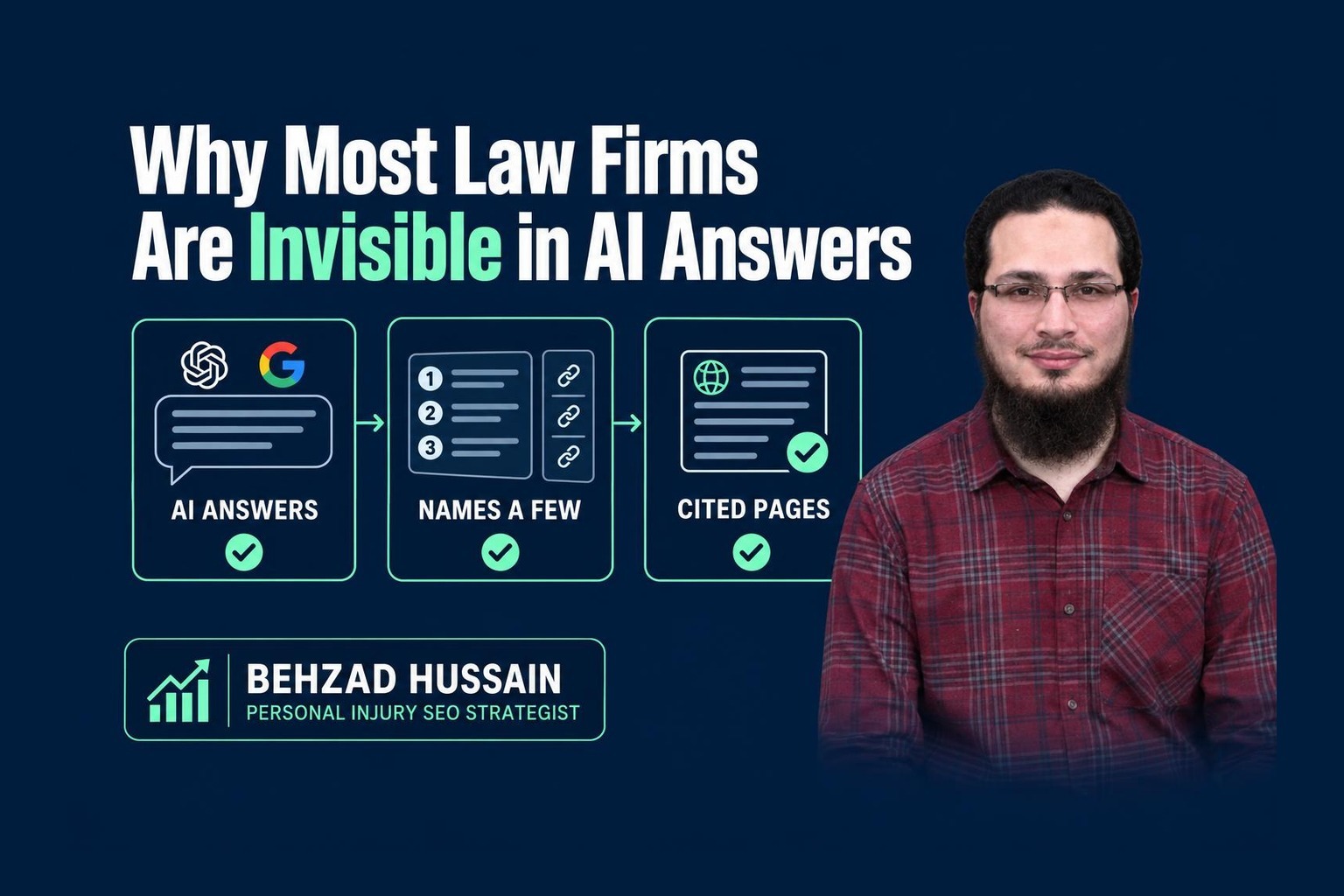
When someone asks ChatGPT or Google's AI Mode "who is the best car accident lawyer near me," they do not get ten blue links. They get a paragraph that names two to five firms, and a short rail of cited pages the assistant chose on its own. If your firm is named, you are in the consideration set. If it is not, you do not exist for that searcher. There is no position eight in an AI answer.
That makes one question urgent for every firm competing in an expensive vertical: who actually gets named, and whose web pages carry the citations? My latest study set out to answer it with data rather than anecdotes. I audited AI citations for 1,000 top-ranking US personal injury law firms, counting per-firm mentions and cited pages separately across four AI answer surfaces: ChatGPT, Gemini, Google AI Overview, and Google AI Mode. I then joined those counts to the signals my earlier studies had already measured for the same firms: brand search volume, Knowledge Panels, domain authority, backlinks, structured data, and organic traffic. Six domains in the sample turned out to be directories and bar associations rather than firms, so every statistic below describes the 994 actual law firms.
Three findings stood out, and each one should change how firms think about AI visibility.
The median firm in the study earned just 22 AI mentions across all four assistants combined. The top 100 firms absorbed 51.6% of all mentions. The bottom 500 firms, half the sample, shared 9.6% between them. The Gini coefficient of the distribution is 0.65, and 33 firms received zero mentions anywhere.
Remember what this sample is. Every one of these firms earned a page-one Google presence for competitive personal injury queries. These are the winners of classic SEO. Yet in the answer layer, most of them are near-invisible while a thin head of nationally branded firms is cited hundreds to thousands of times. One more number frames the imbalance: a single university legal directory in the raw data out-mentioned all 994 law firms combined, 107,492 mentions against their 47,385. AI assistants lean hard on institutional sources in legal.
Across firms, the four assistants rank the same winners: pairwise rank correlations run from 0.70 to 0.88. Google AI Overview is the largest single surface, hosting 37% of all firm mentions, while ChatGPT hosts 16%.
The divergence is in absence, and it is one-directional. In the study, 126 firms were visible on Google's AI surfaces yet completely absent from ChatGPT. Only 14 firms showed the reverse pattern. Roughly one top-ranking firm in eight is a Google-only AI citizen. The mechanism is infrastructure: ChatGPT's search retrieves through Microsoft's stack, and industry analyses find the large majority of its citations coincide with Bing top-ten results. A firm that is under-indexed in Bing is structurally under-cited in ChatGPT, no matter how strong its Google presence looks. If your AI-visibility audit reports one aggregate score, it is hiding exactly this blackout.
The study introduces a metric called the Citation Intermediation Ratio (CIR): the share of a firm's AI citation footprint hosted by domains other than its own. The median CIR is 0.72. Seventy-two percent of the typical firm's AI citations sit on third-party surfaces, with legal directories such as SuperLawyers, Justia, and Avvo alone hosting about a quarter. Only 8 of 954 measurable firms achieved majority own-site citation share, and for a third of firms, the directories out-cite the firm's own website.
There is an escape gradient. As brand demand rises across quartiles, own-site share climbs from 22% to 30%, and the unstructured web gets displaced. The directory share, though, holds constant at every size stratum. Directories are the last intermediary a firm outgrows, not the first.
Domain authority dominates everything: its rank correlation with AI mentions is 0.80, and firms in the top authority decile carry a median of 148 mentions against 4 for the bottom decile. Brand search demand, the volume of people googling the firm by name, is the strongest lever a firm actually controls, staying significant even after authority is held constant. Structured data helps modestly.
The surprise is the Knowledge Panels. The attorney-side Person Entity Panel is citation-neutral. The firm-side Google Business Panel is associated with a citation deficit: firms with a strong Business Panel carry a median of 19 mentions against 36 for firms without one, and the gap survives statistical controls. My read is substitution rather than penalty. A firm whose presence is concentrated in the Maps and local-pack ecosystem often lacks the open-web documentation that answer engines retrieve and cite. Panels are display surfaces; citations are retrieval outcomes. They reward different investments.
The study closes with a framework I call Citation Surface Optimization. Five moves follow directly from the data. First, audit per assistant, not in aggregate: a four-column table of mentions and cited pages across ChatGPT, Gemini, AI Overview, and AI Mode, checked across repeated runs. Second, keep funding authority: referring domains and digital PR explain more citation variance than everything else combined, so they are the citation budget, not legacy SEO spend. Third, build brand demand deliberately; it pays twice, in traffic and in citations. Fourth, treat directory profiles as AI infrastructure: complete, review-rich profiles are the cheapest citable surface a smaller firm can manufacture, and the primary remediation channel for the ChatGPT-dark cohort. Fifth, publish the owned pages that let retrieval prefer your account of yourself (attorney bios with schema, case results, jurisdictional guides), and track your CIR quarterly. A falling CIR at constant mention volume means your citation portfolio is shifting from rented to owned.
The AI citation contest is not a new kind of inequality. It is the old authority inequality, amplified by an answer format that names three firms where a search page listed ten, and intermediated by a directory layer that hosts the vertical's reputation. The firms that win it will be the ones that measure it.